The Secret to Finding the Best Tasting Beef Is...
posted on
June 9, 2026
Once your taste buds have experienced food with true flavor, they aren't as easily fooled by the inferior stuff you find in most grocery stores and restaurants these days.
But what is it that causes those superior flavor profiles?
Well, it all starts in the soil. Which is synergistically connected to what you see aboveground too. Biology IN the soil is hugely important for nutrient uptake in plants. And diversity both below and above is crucial for a wide array of relationships between microbes and roots of plants. These relationships provide what is necessary to create phytonutrients, which can be not only flavor compounds, but also health-enhancing nutrients.
As you might imagine, what's going on below ground can make or break the health of the plant. And a grazing animal knows the difference. They know when a particular forage or herb or forb has more to offer.
Case in point: in the photo below, this area at the edge of the barnlot has had a lot of fertility added over the past 8-10 years or so. First, we were able to get several loads of wood chips dumped here. We fed pigs here at least a couple years. Whenever the cows graze this pasture, they definitely like to hang out under the mulberry trees in hot weather. So there's plenty of manure and urine added from that too.
Weeds grow very well here. The nutrition belowground shows above. Right before I turned my cows in here after milking this week, I took a photo to show this patch of giant ragweed because I knew what it was going to look like after a short time.

This is how it appeared 3 hours later, right after I gave them their second break. Another patch of giant ragweed to the right of those three cows growing atop a pile of composted manure would also soon be demolished.

You can see as well that any low mulberry branches within reach of cow tongues were stripped of their leaves. Tree leaves are very nutritious, in no small part due to the tree's impressive root system underground.
Over the weekend the cows were finishing up the back end of another pasture. This part of the farm actually had been disturbed in the 1980's from coal mining. The soil has been fairly poorly performing since then. Poor moisture-holding capacity and little to no aggregation of soil particles. Plant growth is stunted, the predominant grass is fescue (not a summertime favorite)--and hardy though it is, even it appears quite lackluster.
Well, maybe about 2 1/2 years ago in the late fall or early winter we had set out a few round bales on one side of the back end of this pasture and strip grazed the section to include some hay with a day's allocation of grass. Most of the hay was consumed, but there is always some "waste" left behind and it eventually decomposes and turns to organic matter in the soil. *Spoiler alert* it's really not wasted...it's an investment in the soil's future.
Last year there were some weeds that came in the circles where the remnants of hay had decayed and temporarily smothered the old feeble grass. At least some of these bales had a significant composition of Eastern Gamma Grass, a warm season perennial that cows love to eat in the summer. And I was excited to see a few sprigs of this grass popping up last year where the bales were fed!
When I turned the cows into this section Sunday afternoon (you can barely see the portable polywire fence in the foreground), the spot where literally the whole herd is grazing is where we fed those hay bales 2 1/2 years ago.

At a closer vantage point in the two photos below, you can see a bit of a color difference in the grasses. Those darker green patches are exactly where those round bales were fed. And you can bet your bottom dollar all those cows knew that grass tasted better!

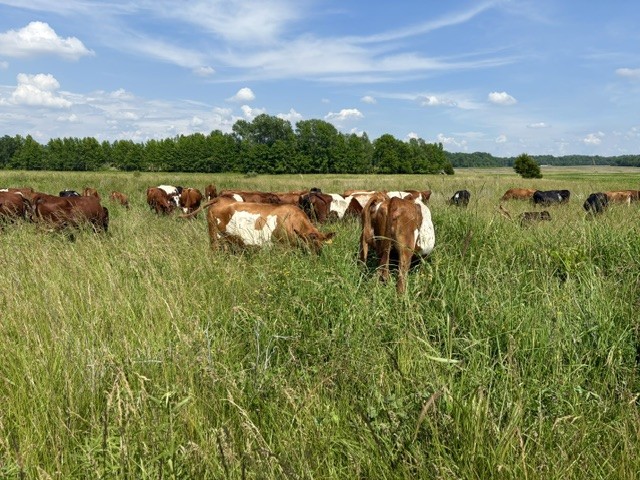
Why was that grass more desirable to the cows? Why did they annihilate a patch of weeds like it was cow candy? It's because what is happening below the surface as a result of meaningful animal impact is translated to plant health, to flavor, and to nutrition.
Does your beef come from a farm where soil life is supported, plant diversity is encouraged, and water and mineral cycles are improved? Because flavorful food will be a happy by-product from a place like that.
Cows really can help heal the soil. And when they do, what they eat gets better and better! Which is exactly what is needed for the best tasting beef.